There are two types of commissions, private or public, both of which I have completed.
Commissions always represent a feat of collaboration, communicating and planning, not just between artist and commissioner, but with other parties too (foundry; maintenance team, plinth maker, installers & van drivers).

“Walking Forwards” installed at the garden of a private sale following the public commission
Both public and private commissions go roughly though similar stages:
- 1. The Commissioner is finding a suitable sculptor, based on their previous sculptures, experience, and style. With public commissions, this is achieved via posting adverts; with a private commission, the commissioner explores the internet to find a sculptor they then approach by email.
- 2. Pricing of the sculpture: With a public commission the fee is determined by the commissioning institution/company, and the artist has to fit their costs within that budget, which determines the size and material of the sculpture. With a private commission, the artist gathers initial quotations from various casters, and based in parts on that, size and material of the sculpture is determined to fit the budget of the commissioner.
- 3. First meeting in a public commission is the interview of several sculptors based on many national applications. Artists bring along either maquettes or images of how they intend to interpret the brief as a sculpture. With a private commission, the first meeting at the Artist’s studio establishes the basic parameters for preparing the maquette(s) for the sculpture: which style and content of the sculpture, which purpose and future location it is intended for. Time frame and budget are further crucial considerations.
- 4. Subsequent meetings to see work in progress, and for the commissioner to have input in artistic decisions (more common with a private commissioner). Typically these meetings are held to see and sign off the finished maquette and later on the completed sculpture. There might be more meeting in-between, or they are replaced by videos and photos of the sculpture in progress.
- 5. Payment is broken down into the stages of the sculpting process: a) Completed Maquette; b) completed sculpture; c) and completed cast. Costs incurred by the sculptor can be: enlarging the maquette; manufacture of the armature; moulding & casting. Moulding and Casting: commissioner is often given a choice about the patination (colouring) of the sculpture.
- 6. Transport and Installation with or without the artist present. The commissioner is financially responsible, but the artist might recommend professionals, advise where to place the sculpture and what material and size of plinth to use. Lighting is often an issue for public sculpture.
- 7. Safety and Maintenance: The patination of the sculpture needs waxing and burnishing once a year to protect it from the corrosive effect of sun and rain. With a public sculpture this poses often a challenge with staff turn-over in the long run. Vandalism can be a slight danger too, prevented by a CCTV camera. With a private sculpture, theft can be an issue and prevented by having the sculpture in a back garden out of view, and installing it firmly onto the plinth. Notifying the insurance of the arrival of the sculpture is also important.

“Family Group” at the caster: rubber mould applied before laying one the resin/glass fibre jacket
Below I recount one example each of a private and public commission I accomplished.
Private Commission: “Family Group”
“Family Group” (initially “Three Sisters”) was initiated by a commissioner who wanted to celebrate his 25 year wedding anniversary with a representation of the three daughters he shared with his wife.
After a thorough email exchange with his ideas and suggested style, we met in person to look around the studio and sculptures.

“Family Group” in bronze 2024
To my relief he preferred my more abstract style, and we based our ideas on “Walking Forwards”, including three rather than two figures.
We had a further meeting when the maquette was well progressed, this time with his wife, herself a creative (she writes crime novels) who very much wanted to be involved in the making of the sculpture.
She preferred the youngest left sister to rest her head against the older one. I managed to convince her of my artistic preference of not doing so, as it was aesthetically important to look through from the front to the back of the sculpture, through the gap between the heads.
Copying over from the small maquette onto the triple sized large sculpture

Copying over from the small maquette onto the triple sized large sculpture
I gave the maquette to a colleague who was able to scan and mill it to threefold enlarge it in polystyrene which I then covered in clay and reworked for five weeks.
As the sculpture was being cast, we had together a look around the foundry; at the patination stage the commissioner watched all day and gave exacting directions. After all, this was HER sculpture (cast) now, and thus it was for HER to make the decisions.
Public Commission: “Walking Forwards”
The commissioner was the chaplain at the Northampton Hospital. Receiving a donation to the chaplaincy, he decided to spend it on a sculpture outside the main entrance of the hospital, in collaboration with the organ donation team.
This was his third art commission he managed, and the largest one. Unusually, he did not place an advert but instead hand picked three sculptors he knew of, resident in his county of Northamptonshire. We were asked to prepare for the interview by responding to his brief and create maquettes.
The brief was to visualise organ donation and transplant, with the purpose to celebrate the relatives of deceased organ donors, and offer them a space in which to reflect; and to inspire members of the public to donate their organs after their death.
The chaplain was faced with the difficult issue of how to touch on the topic of death related to organ donation – not at all an easy proposition, in front of a hospital where people hope to get better.
So he took recourse to a book explaining death and grief to children (“The dragonfly story”), with the metaphor for death and life thereafter as a bug transforming into a dragonfly; a story he often used when assisting at funerals.
I ignored this brief completely at considerable risk of failing to win this competition. I thought a dragonfly mid-metamorphosis from its pupae stage would just not communicate the story of organ donation effectively on a visual level.
It also simply felt wrong to have a sculpture of a dragonfly in front of a hospital; this might have been more suitable for a nature reserve.
I created five Maquettes, all interpreting the brief of that particular kind of given help and self-sacrifice associated with organ donation, with two human abstract human figures; one maquette developed into a small sculpture in its own right (“Standing Together”).

“Standing Together”, based on one of the maquette for the hospital
At the interview the chaplain and various members of the organ donation team were present. The chaplain let me know straight away that he was very unhappy I had not included a dragonfly in my maquettes; however, the other members of his interview team seemed to warm to my suggestions, with the third maquette chosen to be enlarged.
The final sculpture describes not only organ donation, but also the more universal theme of a caring and supportive relationship suitable for a hospital entrance, with the dynamic two figures expressing the strong bonds of friendship, empathy and solidarity.
The back figure (the donor) is protective of the the front figure (the recipient), who appears strong and striding purposefully into the future.
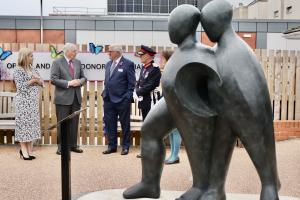
The Duke of Gloucester attending the inauguration of the sculpture in front of the Northampton hospital in 2024
The whole process from the interview in 2016 to the sculpture’s installation in 2021 and its inauguration in 2024 suffered many delays: a new hospital entrance being planned and built; Covid in 2020; and I had various problems with casting.
Interestingly enough, before the signage was installed to explain the meaning and context of the sculpture, many people spontaneously interpreted it as re-presenting a nurse helping a COVID patient.
I was permitted to cast the sculpture to an edition of nine, and subsequently exhibited it in several galleries and sold it to three clients.