Casting a bronze sculpture
Bronze casting is far from a quick or simple process. While the finished sculpture may appear timeless and effortless, the journey from concept to completion is intricate and time-consuming. Rooted in the ancient lost-wax method – used for thousands of years in cultures such as Benin, Greece, Rome, and India – the process today blends tradition with modern foundry techniques. So, how long does it take? The answer can range from several weeks to half a year, depending on the sculpture’s size and complexity.
Here, we look at the process of casting a bronze sculpture and what can affect the time required. Each stage of the process has its own workshop space and staff, and a queuing system in place to allocate time and arrange workload.
The process involved in casting a bronze sculpture
1. Mould Making
A detailed mould is created using a soft rubber layer to capture texture, reinforced with firmer rubber and a rigid resin shell. This ensures accuracy and durability. Depending on size, it typically takes a week or more.

Creating a rubber and resin mould
2. Wax Casting
Hot wax is layered into the mould to form a hollow replica. Once hardened, the wax is assembled, refined, and signed. Larger works may be cut into sections. This stage can take days to a couple of weeks.

Cutting the wax into smaller parts
3. Gating System
Wax sprues, a pouring cup, and risers are added to guide molten bronze and release air. Though relatively quick, this step is essential for a successful cast.
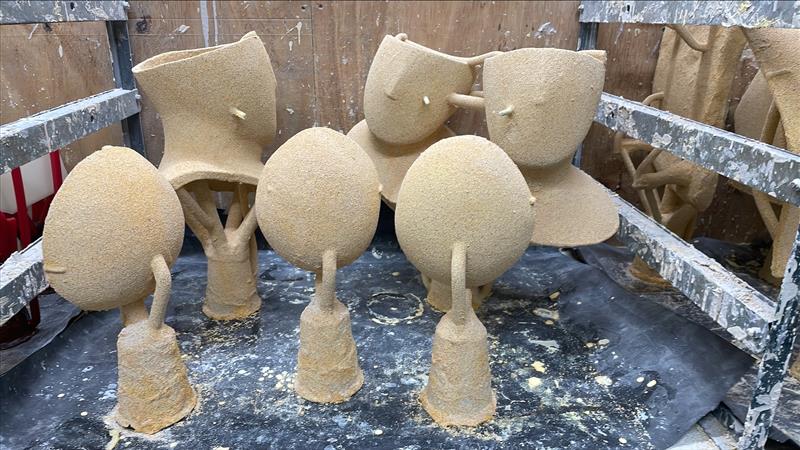
4. Shell Formation
The wax model is dipped repeatedly in ceramic slurry to build a heat-resistant shell. Each layer must dry before the next, making this a slow process lasting several days or more.
5. Wax Removal
The piece is heated in a kiln so the wax melts out, leaving a hollow ceramic mould. This step usually takes a day or two.

Bronze being heated up
6. Bronze Pouring
Bronze is melted to around 1,000°C and carefully poured into the mould by a skilled team. The pour is quick, but preparation is critical.
7. Cooling and Removal
The bronze cools and solidifies before the ceramic shell is removed. Excess materials are cut away, and the surface is cleaned. This can take several days.
8. Reassembly and Chasing
Sections are welded together if needed, then refined through grinding and sanding to restore detail. This can take days or weeks.

Reassembly and chasing
9. Patination
The surface is heated and treated with chemicals to create colour and character, often involving both artist and specialist.
10. Sealing and Finishing
A protective wax or lacquer is applied and polished, ensuring durability and a refined finish.

A finished bronze sculpture, ‘Family Group‘
What can influence the time it takes to cast a bronze sculpture?
The time required to cast a bronze sculpture can vary significantly depending on a range of technical, artistic, and logistical factors. These include:
Size of the sculpture
Larger sculptures naturally take longer to mould, cast, and finish. They often need to be made in multiple sections, each of which must be individually produced, cleaned, and later welded together.
Complexity of the design
Intricate surfaces, fine textures, and detailed forms require more careful mould-making, wax work, and chasing. The more complex the design, the more time is needed to preserve accuracy.
The number of sections
If a sculpture must be divided into several pieces for casting, each section goes through the full bronze casting process separately.
Drying and curing times
Many stages, for example, rubber moulds, ceramic shell building, and investment layers, require full drying or curing before the next step can begin. It’s important that these stages aren’t rushed, as this could impact the overall quality of the final product.
Bronze casting takes time because it is a controlled, high-risk, multi-stage craft that blends science with artistry. From the earliest stages of mould making through to final patination, every step requires careful timing, technical precision, and artistic judgement. Find out more about the stages involved in casting a bronze sculpture.
If you would like to see the results of this process in action, why don’t you have a browse of my sculptures? I offer a bespoke service, which I can discuss with you. Please get in touch.